Technology helps us work, learn, stay entertained and connect with loved ones. But getting more from your devices doesn’t always require an upgrade or a new app. Sometimes, a keyboard shortcut or an everyday household item can make a familiar task easier.
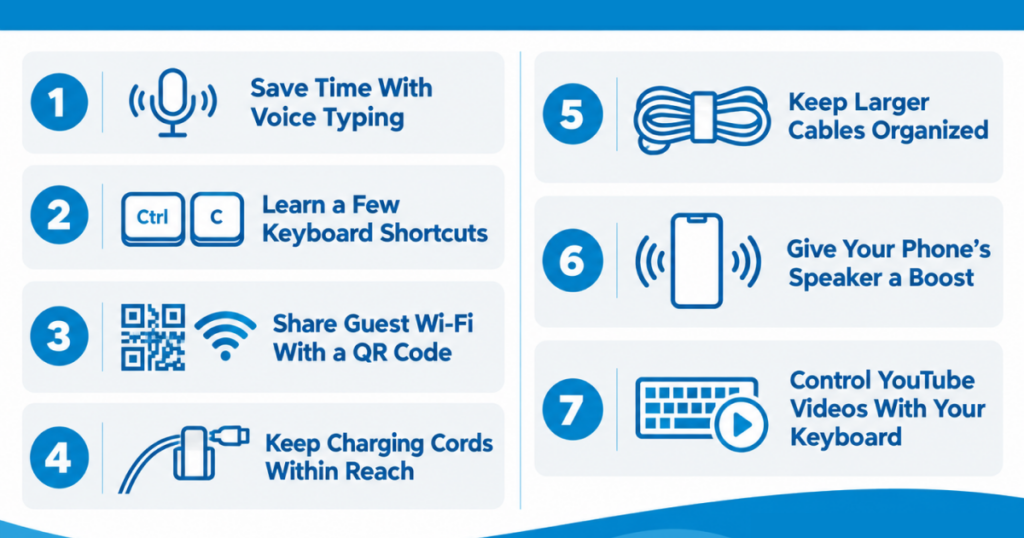
Whether you want to spend less time typing, simplify Wi-Fi access for visitors or finally tackle that drawer full of tangled cables, these seven tech hacks are easy places to start.
1. Save Time With Voice Typing
Writing a long document or getting ideas down quickly can mean plenty of time at the keyboard. Voice typing gives your hands a break by turning spoken words into text. It can also be helpful when an injury makes typing uncomfortable.
Both Microsoft Word and Google Docs offer tools to get you started:
- Microsoft Word: Open your document and select Home > Dictate. You’ll need a supported version of Word and a working microphone. See Microsoft’s dictation guide for details.
- Google Docs: Open your document in Chrome, then select Tools > Voice typing. Allow microphone access and click the microphone to begin. See Google’s voice typing instructions.
For better results, choose a quiet space and speak clearly at a natural pace. Voice typing is especially useful for rough drafts, brainstorming and capturing thoughts before you forget them. Review the finished text to catch any missed words or punctuation mistakes.
2. Learn a Few Keyboard Shortcuts
Reaching for the mouse may feel automatic, but keyboard shortcuts can make common tasks quicker. Learning just a few can help you move between apps, find information and recover an accidentally closed browser tab.
Try these while browsing or working on your computer:
| Action | Windows | Mac |
| Scroll down a webpage | Spacebar | Spacebar |
| Scroll up a webpage | Shift + Spacebar | Shift + Spacebar |
| Switch between open apps | Alt + Tab | Command + Tab |
| Find a word or phrase on a page | Ctrl + F | Command + F |
| Reopen a closed browser tab | Ctrl + Shift + T | Command + Shift + T |
| Open a link in a background tab | Ctrl + click | Command + click |
Start with two or three shortcuts that fit your daily routine. If you regularly read long articles, for example, scrolling and searching shortcuts can be especially useful.
Shortcuts can vary by browser or app. For scrolling shortcuts, click an empty area of the webpage first so you aren’t typing into a text field.
3. Share Guest Wi-Fi With a QR Code
Helping visitors get online often involves reading a long password aloud—and then repeating it when someone misses a character. A Wi-Fi QR code makes the process easier. Guests with compatible phones can scan the code instead of entering the details manually.
If your router supports a guest network, set one up and use its network name and password to create a code at QiFi. Print the code and place it somewhere convenient, such as a welcome card or a small frame in the guest room.
Give the printed code a clear label so visitors know what it’s for. Keep a written version of the network name and password available for anyone whose device cannot scan it.
Remember that the QR code contains your Wi-Fi login details. Share it only with people you want to give access and create a new code whenever you change the network name or password.
4. Keep Charging Cords Within Reach
A charging cable that slips behind a desk or nightstand can be a small but recurring frustration. A LEGO minifigure offers a playful way to keep a compatible cable close at hand.
The figure’s hands may be just the right size to hold a thin charging cord. Attach the minifigure to a LEGO brick or base on your desk, then gently slip the cord into its hand. Position the holder near the edge of your workspace so the connector is easy to grab when you need it.
This can be a fun addition to a home office, study area or family charging station. Let each person choose a figure to help identify their charging spot.
Cable sizes vary, so choose one that fits comfortably without forcing it into place or pinching its outer covering.
5. Keep Larger Cables Organized
Spare charging cables, computer cords and other accessories can quickly become a tangled mess in a drawer or storage box. Empty toilet paper rolls offer a simple, inexpensive way to keep them separated.
Loosely coil each cable, slide it into a cardboard roll and label the roll with the device or accessory it belongs to. Then arrange the rolls in a box or drawer so the labels are easy to see.
For cables with bulky adapters, tuck the coiled cord inside the tube and leave the adapter outside. You can also group cords by purpose—such as phone chargers, computer accessories or TV cables—to make finding the right one easier.
Follow this step-by-step tutorial from Housewife Eclectic to create your own labeled cord holders. Add decorative paper or colorful labels if you want the storage box to look a little more polished.
6. Give Your Phone’s Speaker a Boost
Want to listen to music or a podcast but don’t have a Bluetooth speaker nearby? Try placing your phone in a clean, dry, empty cup with its speaker pointing toward the bottom.
The cup can redirect the sound and make it seem louder. Results vary depending on the phone’s speaker placement and the cup’s shape, so experiment with the position to find what sounds best.
This trick can be useful when you’re listening at a desk or getting ready in the morning. Choose a cup that holds the phone securely, and keep it away from liquids and the edge of the counter.
It’s a quick option for casual listening when your phone’s built-in speaker needs a little help.
7. Control YouTube Videos With Your Keyboard
Following a tutorial or trying to catch something you missed in a video? YouTube’s keyboard shortcuts let you pause, rewind and adjust playback without searching for the right button onscreen.
While watching on a computer, try these built-in keyboard shortcuts:
| Key | Action |
| K | Pause or resume playback |
| J | Rewind 10 seconds |
| L | Fast-forward 10 seconds |
| F | Enter or exit full screen |
| M | Mute or unmute |
The rewind shortcut is particularly handy for recipes, craft projects and other instructional videos. If you miss a step, tap J to hear it again, then press K when you need time to follow along.
Click the video first if the shortcuts aren’t responding, and make sure you’re not typing in a search box or comment field.
Get More From Your Everyday Technology
A few small changes can make everyday technology easier to use. Start with a shortcut that saves you time or an organizing trick that solves a familiar frustration, then try another as it fits your routine.
Looking for services that help keep your household connected? Visit ftc.net to explore FTC’s fiber internet, wireless, phone, and security options.